Introduction
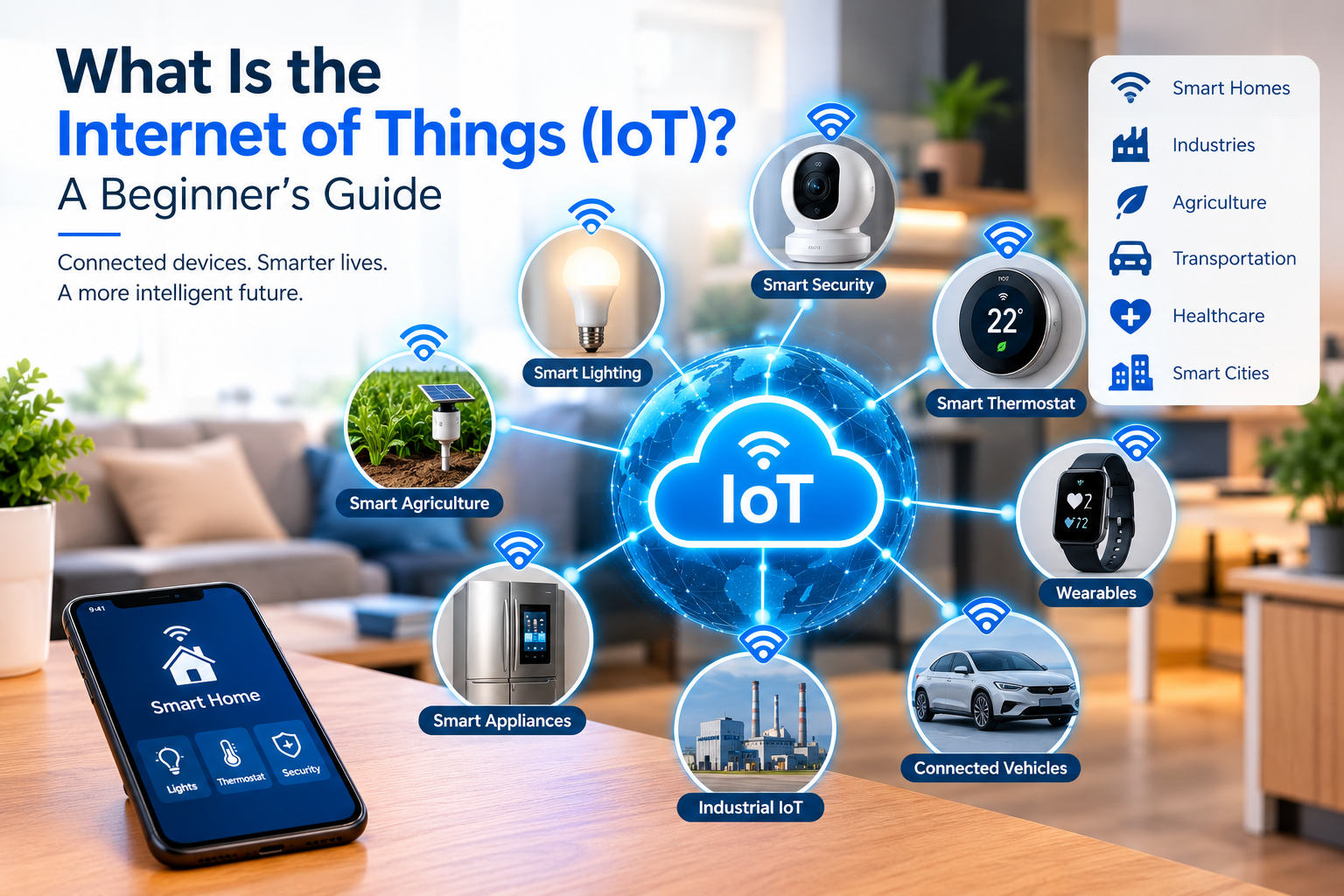
Imagine coming back home from a tiring day and realizing that the climate of your room is already pleasant. Your lights can be controlled from your phone, your smartwatch tracks your daily activity, and your home security camera lets you check your property while you are away. These technologies may seem separate, but they share one important idea: connected devices that can exchange information and respond to instructions.
This is the basic idea behind the Internet of Things, commonly known as IoT.
It is used in homes, hospitals, factories, farms, transport systems, and many other environments. By connecting physical devices to networks, IoT can help people monitor conditions, automate tasks, and make better use of information.
Please note that these are just examples of IoT applications. However, IoT is more than just smart home devices.
In this guide, we will explain what the Internet of Things means, how it works, where it is used, its benefits and limitations, and how beginners can start learning about this technology.
What Is the Internet of Things?
The Internet of Things refers to a network of physical objects equipped with technologies that allow them to collect information, communicate with other systems, or perform actions based on instructions.
These objects are often called IoT devices. They can include household appliances, environmental sensors, wearable devices, vehicles, industrial equipment, and many other products.
An IoT device may contain sensors, software, a processor, and a communication interface. Depending on its purpose, it might connect through Wi-Fi, Bluetooth, a mobile network, or another communication technology.
For example, a smart temperature sensor can measure the temperature in a room and send that information to a compatible application. A user can then view the reading on a smartphone or use it to control a connected heating system.
Not every IoT device needs a direct connection to the internet at all times. Some communicate through a local hub or gateway that passes information to another system.
The central idea is that physical devices can collect or exchange data and use that information to support monitoring, automation, or decision-making.
How Does the Internet of Things Work?
IoT systems combine physical devices, software, communication networks, and applications. Each part has a specific role in collecting information and making it useful.
1. Sensors Collect Information
Numerous IoT devices make use of sensors in order to gather information about their environment.
A temperature sensor measures heat, a motion sensor detects movement, and a soil moisture sensor measures the amount of moisture in the soil.
The type of sensor depends on the purpose of the device. Some devices also collect information about location, light levels, pressure, humidity, or vibration.
As an example, a sensor placed in a greenhouse may measure temperature and humidity throughout the day . These readings can help the owner understand whether the growing environment needs adjustment.
2. The Device Processes the Data
After collecting information, the device may process it locally using a small processor or microcontroller.
Some devices perform simple tasks, such as checking whether a temperature has crossed a set limit. Others send the collected information to a more powerful computer or cloud platform for further analysis.
Local processing can reduce communication delays and allow certain functions to continue when internet access is unavailable.
3. Information Travels Through a Network
The device communicates with another system through a suitable connection.
A smart home device may use Wi-Fi, while a wearable device may use Bluetooth to communicate with a smartphone. Industrial sensors might use wired connections or specialised wireless technologies.
The choice depends on factors such as communication range, power consumption, cost, and the amount of data being transferred.
4. Software Interprets the Information
The collected data can be displayed in an application, stored in a database, or processed by software.
For example, a smart energy monitor may show how much electricity a household is using. An industrial monitoring system may identify unusual vibration patterns in a machine.
The software helps turn raw measurements into information that people can understand and use.
5. The System May Trigger an Action
Some IoT systems do more than collect information. They can also trigger actions automatically.
A smart thermostat might adjust the heating when the temperature falls below a chosen level. The irrigation system may be turned on based on the reading of soil moisture that is below some preset level.
These actions depend on the device’s capabilities, settings, and safety controls. More advanced systems may use historical information or predictive models to decide when an action is appropriate.
Common Types of IoT Devices
IoT devices serve different purposes, from making household tasks easier to monitoring complex industrial processes.
Smart Home Devices
Smart home technology includes connected lights, thermostats, security cameras, door sensors, and compatible appliances.
Users may control these devices through mobile applications, voice assistants, or automatic routines.
For example, a homeowner might schedule lights to switch off at a particular time or receive an alert when a connected door sensor detects an opening.
The available functions depend on the device and the platform supporting it.
Wearable Technology
Wearable devices include smartwatches, fitness trackers, and certain health-monitoring devices.
They may collect information such as steps, movement, heart rate, or sleep-related measurements, depending on their sensors and capabilities.
This information can help users understand activity patterns. However, consumer wearables do not replace professional medical equipment or medical advice when health concerns require proper assessment.
Industrial IoT Devices
The Industrial Internet of Things, often called IIoT, applies connected sensing and monitoring technologies to industrial environments.
Factories may use sensors to monitor equipment temperature, vibration, pressure, or energy consumption.
The collected data can help maintenance teams identify unusual operating conditions and investigate problems before they cause major interruptions.
Industrial systems require careful planning because unreliable data, insecure connections, or incorrect automatic actions can affect production and safety.
Smart Agriculture Devices
A variety of IoT devices are brought to use in farming, mainly to check and keep track of soil moisture, temperature and humidity, etc.
For example, a connected irrigation system may use soil measurements to help determine when watering is needed.
This can support more informed decisions about water use, although the results depend on sensor accuracy, crop requirements, weather conditions, and the quality of the system’s configuration.
Connected Vehicles
Some vehicles contain systems that communicate with external services or other devices.
Depending on the vehicle, these systems may support navigation, maintenance alerts, vehicle tracking, remote features, or traffic information.
Connected vehicle technology can improve convenience and provide useful information, but it also raises questions about data privacy, system security, and reliable connectivity.
Real-Life Examples of the Internet of Things
The easiest way to understand IoT is to look at how connected devices are used in everyday situations.
Example 1: A Smart Home
Consider a family that installs connected lights, a thermostat, and a security camera.
The family can control the lights through an application, check the indoor temperature remotely, and view camera footage when needed.
Some tasks can be automated through schedules or configured rules. For instance, lights may switch off at bedtime, while a thermostat adjusts the temperature according to a chosen schedule.
These features can make household management more convenient, but the devices need appropriate configuration and security.
Example 2: Monitoring Equipment in a Factory
Imagine a factory that uses machines throughout the day.
Sensors attached to important equipment can collect information about vibration and temperature. A monitoring system can display the readings and alert staff when measurements move outside expected ranges.
Maintenance teams can investigate the issue before deciding whether repairs are necessary.
This does not mean every machine problem can be predicted, but continuous monitoring can provide information that would otherwise be difficult to collect regularly.
Example 3: Connected Farming
A farmer may install sensors in different parts of a field to measure soil moisture.
Instead of relying only on visual inspection, the farmer can compare readings and identify areas that may need more attention.
When connected to an irrigation controller, the system may also help automate watering according to configured conditions.
The usefulness of this approach depends on the placement of sensors, local soil conditions, and suitable irrigation planning.
Example 4: Smart Energy Monitoring
A connected energy monitor can record electricity consumption and display it through an application or dashboard.
Users may notice which appliances consume more energy or when electricity use increases.
This information can help households or businesses make informed decisions about energy use. The monitor itself does not automatically guarantee lower bills; savings depend on the actions taken and the applicable electricity rates.
Benefits of the Internet of Things
IoT offers several potential advantages when devices are selected, configured, and maintained properly.
Automation of Routine Tasks
IoT can automate repetitive activities that would otherwise require manual attention.
Connected lights can follow schedules, sensors can trigger alerts, and compatible systems can adjust settings when specific conditions occur.
Automation can save time, particularly when tasks happen regularly or involve many devices.
Better Monitoring
Traditional monitoring may require someone to inspect equipment or record measurements manually.
Connected sensors can provide frequent readings and make them available through a dashboard. This can help people notice changes and investigate problems more quickly.
Improved Efficiency
In homes, businesses, and industrial environments, IoT data can help identify unnecessary energy use, unusual equipment behaviour, or inefficient processes.
The resulting improvements depend on whether the information is accurate and whether users act on it appropriately.
Support for Better Decisions
IoT systems can provide information that was previously difficult to collect.
For example, a warehouse can monitor environmental conditions, while a farmer can compare soil moisture across different areas.
These measurements can support decisions, although they should be interpreted in context rather than treated as automatically correct.
Remote Access
Many connected systems allow users to view information or control compatible devices from a distance.
A business owner may check a monitoring dashboard while away from the workplace, or a homeowner may review a connected security camera remotely.
Remote access is convenient, but it must be protected with suitable authentication and security settings.
Challenges and Disadvantages of IoT
Although connected devices can be useful, they also introduce technical and practical challenges.
Security Risks
Every connected device may create another point that needs protection.
Devices with weak passwords, outdated software, or insecure communication can expose users and organisations to security problems.
A compromised device might reveal information, provide an entry point into a wider network, or be misused for harmful activity.
Users should change default passwords, install updates, enable multi-factor authentication where available, and avoid exposing device management interfaces unnecessarily.
Privacy Concerns
Some IoT devices collect information about household routines, location, activity, or the surrounding environment.
If this information is stored or shared without adequate safeguards, it may create privacy risks.
Before purchasing a device, review its privacy settings, the information it collects, its data-sharing practices, and the available options for deleting stored information.
Dependence on Connectivity
Certain IoT features rely on an internet connection or a cloud service.
If the connection becomes unavailable, remote access and cloud-based functions may stop working. Some devices continue to operate locally, while others have limited functionality without connectivity.
It is important to understand what happens when a device loses its connection, especially when it is used for an important task.
Compatibility Problems
Devices from different manufacturers do not always work together smoothly.
They may use different communication standards, applications, accounts, or smart home platforms.
Checking compatibility before purchasing equipment can prevent unnecessary expense and frustration.
Maintenance Costs
IoT systems may require replacement batteries, software updates, connectivity services, or periodic equipment replacement.
Larger deployments can also require installation, monitoring, and technical support.
The total cost should be considered before introducing a connected system, rather than looking only at the initial purchase price.
Handling Large Amounts of Data
A system with hundreds or thousands of sensors can generate a substantial amount of information.
Organisations need appropriate methods to store, organise, protect, and analyse this data. Poor data management can make information difficult to use and increase operational costs.
How IoT Devices Connect to the Internet
IoT devices use different communication technologies depending on what they need to do.
Wi-Fi
Wi-Fi is common in smart home products and devices that need to transfer data through a local wireless network.
It can support applications such as cameras and connected appliances, but power consumption and coverage need to be considered when selecting equipment.
Bluetooth
Bluetooth is commonly used for communication between nearby devices.
For example, a fitness tracker may communicate with a smartphone through Bluetooth. Bluetooth Low Energy is designed for applications that need to reduce power consumption.
Cellular Networks
Some IoT devices use mobile networks to communicate over wider areas.
Examples include certain tracking systems, remote monitoring equipment, and connected vehicles.
Cellular connectivity can be useful where Wi-Fi is unavailable, but coverage, subscription costs, and power requirements vary.
Zigbee and Other Low-Power Technologies
Some smart home and sensor systems use Zigbee or other communication technologies designed for particular network requirements.
These technologies can support low-power devices and communication between multiple connected nodes. Their suitability depends on the application, supported equipment, and network design.
Wired Connections
Not all IoT devices use wireless communication.
Industrial equipment may use Ethernet or other wired technologies when stable connections and predictable performance are important.
The best connection depends on the environment, power requirements, communication range, reliability needs, and cost.
The Role of Artificial Intelligence in IoT
Artificial intelligence and IoT can work together to make connected systems more useful.
IoT devices collect information from the physical world, while AI systems can analyse data, recognise patterns, or generate predictions.
For example, an industrial monitoring system may collect machine vibration measurements. An AI model trained on suitable data may help identify patterns associated with unusual operation.
In a smart building, software may analyse historical energy consumption and environmental conditions to suggest more efficient settings.
However, AI is not required for every IoT application. A simple sensor that switches on a light when it detects movement may operate through a straightforward rule without using machine learning.
AI-based decisions also depend on data quality, appropriate testing, and ongoing monitoring. Incorrect predictions can lead to unnecessary alerts or unsuitable actions.
Is the Internet of Things Safe to Use?
IoT can be used safely, but security should be considered from the beginning.
A connected camera, smart television, or thermostat may contain software that requires regular updates. If updates are ignored, known vulnerabilities may remain unaddressed.
Start by changing default passwords and using strong, unique credentials. Enable additional authentication protections where available and install updates from trusted sources.
It is also sensible to review the permissions requested by companion applications and disable features that are not needed.
For home networks, placing compatible IoT devices on a separate guest network or dedicated network segment may help limit their access to personal computers and other sensitive equipment. The effectiveness of this approach depends on the router and its configuration.
Businesses should take additional care with access permissions, network monitoring, device inventories, and incident response procedures.
No single measure eliminates every risk. Security works best when device manufacturers, network administrators, and users all take appropriate precautions.
How Beginners Can Start Learning IoT
You do not need to build a complex smart home or industrial system to begin learning about the Internet of Things.
A simple learning plan can introduce the most important concepts.
Step 1: Learn Basic Electronics
Begin by understanding basic electrical concepts, sensors, power supplies, and simple circuits.
You do not need advanced electronics knowledge at the beginning, but understanding how a sensor receives power and produces a measurement will help.
Step 2: Understand Computer Networking
Study IP addresses, Wi-Fi, Bluetooth, routers, and the basics of how devices exchange information.
Networking knowledge helps explain how IoT devices communicate with applications and other systems.
Step 3: Explore Microcontrollers
Microcontrollers are small computing devices used in many electronic projects.
Beginner-friendly boards can help you learn how to read sensor values, control simple outputs, and write basic programs.
Always follow the manufacturer’s electrical and safety instructions when working with hardware.
Step 4: Build a Simple Sensor Project
A beginner project might use a temperature sensor to display room temperature or a light sensor to measure brightness.
Start by collecting readings and displaying them locally. Once the basic project works, explore sending the readings to another device or dashboard.
This approach allows you to learn one concept at a time.
Step 5: Learn About Data and Applications
Many IoT systems send information to a dashboard, database, or application.
Learn how data is represented, transmitted, stored, and displayed. You can begin with a simple local dashboard before exploring more complex cloud services.
Step 6: Make Security Part of Your Learning
Use strong passwords, keep software updated, and avoid exposing experimental devices directly to the public internet.
Practise only with equipment and networks you own or have permission to use.
Developing secure habits early can prevent problems as your projects become more advanced.
What Is the Future of the Internet of Things?
IoT continues to develop as sensors, communication systems, processors, and software improve.
Connected devices are being used in areas such as building management, manufacturing, agriculture, transport, and environmental monitoring.
One area of development is edge computing, where some data processing takes place close to the device rather than relying entirely on a remote server. This can reduce communication delays and limit the amount of information that needs to be transmitted.
Another area is the integration of IoT with AI, allowing some systems to analyse data and support more informed decisions.
Interoperability is also important. Better support for common standards can make it easier for devices from different manufacturers to communicate.
At the same time, privacy, security, reliability, and energy consumption remain important challenges. The value of IoT will depend not only on how many devices become connected, but also on whether those devices solve real problems and can be maintained responsibly.
Frequently Asked Questions (FAQs)
What does IoT stand for?
IoT stands for the Internet of Things. It refers to physical objects equipped with technologies that allow them to collect data, communicate, or perform actions through connected systems.
What are some examples of IoT devices?
Examples include smart thermostats, connected security cameras, fitness trackers, environmental sensors, smart appliances, industrial monitoring equipment, and certain connected vehicles.
Does every IoT device need the internet?
No. Some IoT devices communicate through a local network, Bluetooth connection, or gateway. Certain functions can continue without internet access, although remote and cloud-based features may become unavailable.
What is the difference between IoT and the internet?
The internet is a global system of interconnected networks. IoT refers to physical devices that use communication technologies to exchange information or interact with other systems, often through the internet.
What are the main benefits of IoT?
IoT can support automation, remote monitoring, resource management, and data-based decision-making. The actual benefits depend on the quality of the system and how its information is used.
What are the main risks of IoT?
Common concerns include security vulnerabilities, privacy issues, compatibility problems, maintenance costs, and dependence on connectivity.
Is IoT difficult to learn?
Beginners can start with simple sensors, basic electronics, and networking concepts. More advanced projects may require programming, cloud platforms, data analysis, and security knowledge.
How is IoT used in business?
Businesses may use IoT to monitor equipment, track environmental conditions, manage energy consumption, and collect operational data. The specific applications depend on the industry’s requirements.
Conclusion
The Internet of Things connects physical devices with software and communication networks, allowing information to be collected and used in practical ways. From smart home products to industrial monitoring systems, IoT is changing how people interact with technology.
Its benefits include automation, remote monitoring, and access to information that can support better decisions. However, security, privacy, compatibility, and maintenance must also be considered.
For beginners, the best approach is to start with simple concepts. Learn how sensors work, understand basic networking, explore a small device project, and practise secure configuration.
As you develop your knowledge, you will gain a clearer understanding of how connected devices operate and where this technology can be useful. IoT is not simply about connecting more objects to the internet; it is about using those connections to solve practical problems.
Leave a Reply