Introduction
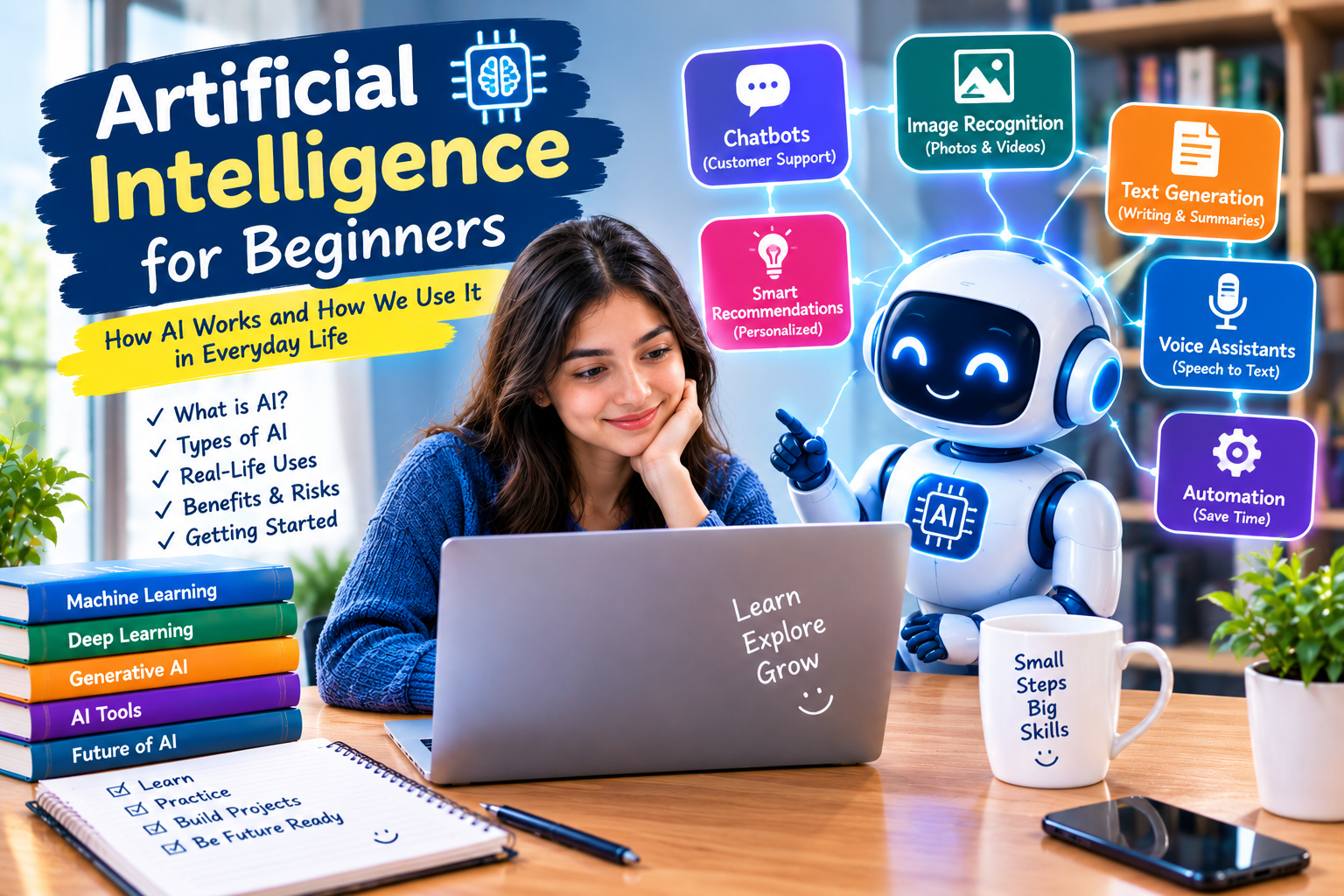
Artificial intelligence, commonly known as AI, has become part of everyday life, even for people who do not realize they are using it. When a smartphone recognizes your face, a navigation app suggests a faster route, or a streaming platform recommends a movie, artificial intelligence may be working behind the scenes.
A few years ago, AI often seemed like something from science fiction. People associated it with robots, futuristic machines, and computers that could think like humans. Today, AI is much more practical. It helps businesses answer customer questions, supports students with learning, assists doctors in reviewing medical information, and makes many digital services easier to use.
Despite its growing popularity, artificial intelligence can still feel confusing to beginners. Some people believe AI can do almost anything, while others worry that it will eventually replace human workers completely. The reality is more complicated. AI is a powerful technology, but it has limitations, requires human oversight, and does not always produce accurate results.
This guide explains artificial intelligence in simple language. You will learn what AI means, how it works, where it is used, what benefits it offers, and what risks you should understand before relying on it.
What Is Artificial Intelligence?
Artificial intelligence is a field of technology focused on developing computer systems that can perform tasks commonly associated with human intelligence.
These tasks may include recognizing patterns, understanding language, analyzing information, making predictions, identifying objects in images, and generating new content.
Commonly, computer programs are based on the commands devised by software engineers. For example, a basic calculator performs calculations according to specific mathematical rules. An AI system, however, may use patterns learned from large amounts of data to classify information, generate responses, or estimate what is likely to happen next.
Consider an email application that automatically identifies unwanted messages. Instead of requiring users to manually identify every suspicious email, an AI-powered filter can analyze characteristics such as wording, sender behavior, links, and other patterns to estimate whether a message is spam.
Artificial intelligence does not mean a computer comprehends the world as a human does. An AI system can produce useful results without possessing human emotions, personal experiences, or human-like awareness.
In simple terms, AI allows computers to perform certain tasks that would otherwise require substantial human judgment or effort.
How Does Artificial Intelligence Work?
Artificial intelligence is not a single machine or program.It is a wide collection of methods, technologies and systems that is created for several needs.
Many modern AI applications rely on data, algorithms, and computing power. The exact process depends on the type of system being used.
1. Data Collection
AI systems often rely on information to identify patterns and perform specific tasks. This information may include text, photographs, recorded speech, numerical values, or other digital material.
For example, an AI system designed to recognize cats in photographs needs examples that help it distinguish cats from other animals and objects.
The quality of this information matters. If the data is incomplete, inaccurate, or heavily biased, the resulting system may also make unreliable or unfair decisions.
2. Learning Patterns
Many AI systems use machine learning, a method that allows computers to learn patterns from data rather than relying entirely on manually written rules.
Imagine a system that helps identify suspicious financial transactions. During development, it may be trained using examples of normal and potentially fraudulent activity. The system learns relationships between different characteristics and uses those patterns to evaluate new transactions.
It does not need to memorize every possible fraudulent transaction individually. Instead, it learns patterns that may help it identify unusual activity.
This process is not perfect. A transaction that appears unusual may be legitimate, and a fraudulent transaction may look normal. That is why many real-world systems require additional checks and human review.
3. Making Predictions or Generating Results
After training, an AI system can use what it has learned to process new information.
Depending on its design, it might identify an object in an image, estimate future demand, recommend a product, summarize a document, or generate a response to a question.
For example, a shopping website may recommend products based on browsing behavior and previous purchases. A writing assistant may generate a first draft based on a user’s instructions.
The result is produced using the system’s learned patterns and the information available to it. It should not be taken as having been established as truth.
4. Testing and Improvement
AI systems need testing to determine how well they perform. Developers evaluate whether a system produces useful, accurate, and consistent results under different conditions.
Some systems can be updated with new training data or improved models. Others remain fixed after deployment until their developers release an updated version.
An important distinction is that an AI application does not necessarily learn from every conversation or action in real time. Whether it remembers information, adapts to feedback, or updates its behavior depends on how the particular product has been designed.
Understanding the Main Types of Artificial Intelligence
AI is often discussed as though every system has the same abilities. In practice, there are several ways to classify artificial intelligence.
Narrow AI
Narrow AI, also referred to as weak AI, is aimed at doing certain tasks or a limited range of tasks.
Examples include voice assistants, recommendation systems, image recognition tools, translation applications, and many customer service chatbots.
These systems can be extremely capable within their intended roles. However, their abilities do not automatically extend to every other task.
A program that can identify objects in photographs, for example, may not be capable of managing a business or explaining a complicated legal document accurately.
Most AI applications currently used by individuals and businesses fall into this category.
General AI
Artificial general intelligence refers to a hypothetical or not-yet-established level of AI that could learn and perform a broad range of intellectual tasks with flexibility comparable to human capabilities.
Researchers and technology companies continue to debate how such a system should be defined and measured.
It is important not to confuse advanced AI tools with proven human-level general intelligence. A system may perform impressively across multiple tasks while still making basic mistakes, struggling with unfamiliar situations, or lacking reliable understanding in particular areas.
Generative AI
Generative AI refers to systems that can create new content based on patterns learned during training and the instructions they receive.
Depending on the model, the output may include written text, images, computer code, audio, video, or other forms of media.
For example, a generative AI tool may help someone draft an email, create a concept illustration, explain a difficult topic, or develop an initial version of a computer program.
Generative AI is especially useful for brainstorming and producing first drafts. However, it can also create incorrect information, misleading images, or code containing errors. Human review remains important.
What Is Machine Learning?
Machine learning is one of the most important approaches used in modern artificial intelligence.
Instead of programming every decision individually, developers train a machine learning model to identify patterns in examples and use those patterns to make predictions or decisions.
There are several common approaches to machine learning.
Supervised learning uses examples that include the correct answer or target outcome. A model might be trained using labeled photographs to distinguish between different objects.
Unsupervised learning looks for patterns or groupings in data without relying on predefined answer labels for every example. A business might use it to discover groups of customers with similar purchasing behavior.
Reinforcement learning involves learning through actions, feedback, and rewards or penalties. It can be used in areas such as game-playing systems, robotics research, and certain optimization problems.
These approaches are not interchangeable, and many modern AI systems combine different techniques.
For beginners, the main idea is straightforward: machine learning helps computers find useful patterns in information, and those patterns can support predictions, classifications, recommendations, or other tasks.
What Is Deep Learning?
Deep learning is a specialized area of machine learning that uses artificial neural networks with multiple processing layers.
These networks are loosely inspired by aspects of biological neural systems, but they are mathematical and computational models rather than replicas of the human brain.
Deep learning has contributed to major advances in image recognition, speech processing, language technology, and generative AI.
For instance, a deep learning model may process an image through several layers that detect increasingly complex features. Early layers may respond to simple visual patterns, while later layers may combine those features to help recognize an object.
Training large deep learning models can require substantial computing resources and large datasets. Once trained, some models can be used through ordinary websites or applications, meaning users do not need powerful computers of their own.
How AI Is Used in Everyday Life
Artificial intelligence is no longer limited to research laboratories. It is integrated into many digital services people use at home, at school, and at work.
Smartphones and Voice Assistants
Smartphones use AI-related technologies for tasks such as speech recognition, image processing, predictive typing, and photo organization.
Voice assistants can interpret spoken requests, set reminders, answer certain questions, or control compatible devices.
Some features work on the device itself, while others send information to remote servers for processing. The exact arrangement depends on the product and settings.
Search Engines
Search engines use a combination of technologies to understand queries, organize information, identify relevant pages, and improve search results.
AI can help interpret the meaning behind a question instead of relying exclusively on exact keyword matches.
For example, someone searching for ways to reduce household electricity consumption may receive relevant information even if the pages use different wording from the original query.
However, search results and AI-generated summaries should still be checked against reliable sources, especially when the subject involves health, finance, law, or safety.
Online Shopping
Online stores may use AI to recommend products, predict demand, improve product searches, and identify suspicious transactions.
Recommendations can save time by highlighting items related to a customer’s interests. They can also encourage unnecessary purchases if people rely on them without considering their actual needs.
Businesses should therefore use these systems responsibly and provide appropriate privacy protections.
Maps and Navigation
Navigation applications use several technologies to estimate travel times, suggest routes, and interpret traffic conditions.
Machine learning may help identify traffic patterns or estimate how long a journey will take. Location information, road data, and live traffic reports can also contribute to these calculations.
An AI-supported route is still an estimate. Road closures, accidents, poor connectivity, and changing conditions can affect its accuracy.
Entertainment and Streaming
Music and video platforms commonly use recommendation systems to suggest content based on viewing history, listening habits, and other signals.
These suggestions can help people discover new material. At the same time, they may repeatedly promote similar content and limit exposure to different interests.
Users can sometimes improve their recommendations by adjusting preferences, removing items from their history, or exploring content outside their usual suggestions.
Email and Online Security
AI can help email services detect spam, identify suspicious links, and flag unusual activity.
Security teams may also use AI-assisted tools to analyze large amounts of information and investigate potential threats.
These tools are valuable, but they do not eliminate online risks. Suspicious messages can still reach an inbox, and legitimate messages can occasionally be flagged incorrectly.
People should continue using strong passwords, multifactor authentication, and careful judgment when opening links or attachments.
How Businesses Use Artificial Intelligence
Businesses are adopting AI to improve productivity, organize information, and support decisions. The most effective applications usually solve a clearly defined problem rather than introducing AI simply because the technology is popular.
Customer Support
AI-powered chatbots can answer common questions, provide basic instructions, and direct customers to the appropriate department.
For example, a home services company could use a chatbot to explain service areas, collect a customer’s contact details, or help arrange an appointment.
More complicated complaints may still require a human representative. Customers should have a clear way to request human assistance when an automated system cannot resolve their problem.
Marketing and Content Creation
Marketing teams can use AI to brainstorm campaign ideas, organize customer feedback, draft promotional material, and explore different messaging approaches.
A small business might use an AI writing assistant to prepare an initial newsletter or develop several versions of an advertisement.
However, publishing generated content without reviewing it can introduce factual errors, generic language, or unsupported claims. Businesses should check information, maintain their own brand voice, and make sure their content provides genuine value to readers.
Data Analysis
Organizations often collect large amounts of information from sales, customer service, operations, and website activity.
AI-assisted analysis can help identify patterns that might otherwise take considerable time to discover.
For example, a retailer might analyze seasonal purchasing trends to improve inventory planning. A service business might review appointment data to understand when demand is highest.
These insights are only as reliable as the underlying data and analysis. Important business decisions should consider context, uncertainty, and human expertise rather than relying blindly on a model’s recommendation.
Repetitive Administrative Work
AI and automation tools can assist with summarizing documents, categorizing incoming requests, extracting information from forms, and preparing routine reports.
Automation is especially useful when a task follows a consistent process and the expected result can be checked.
Businesses should be cautious when automating tasks that involve sensitive information, unusual circumstances, or decisions with significant consequences.
Benefits of Artificial Intelligence
AI can provide meaningful benefits when it is applied to appropriate tasks and managed carefully.
Saving Time
AI tools can process certain kinds of information quickly and assist with repetitive activities. This can leave people with more time for planning, communication, problem-solving, and other work that requires judgment.
The time saved depends on the task. Reviewing and correcting an AI-generated result may take longer than doing the work manually if the output is inaccurate or poorly suited to the situation.
Handling Large Amounts of Information
People can struggle to review thousands of records or identify patterns across large datasets. AI can help process this information and highlight areas that deserve closer attention.
This capability is useful in areas such as logistics, customer support, scientific research, and fraud detection.
It does not mean every pattern identified by a model is meaningful. Human review and appropriate statistical testing may still be necessary.
Supporting Learning
AI tools can explain concepts in different ways, provide practice questions, and help learners identify areas they do not understand.
A student learning programming, for example, might ask an AI assistant to explain an error message or walk through a basic coding concept.
Students should use these tools to strengthen their understanding rather than simply copying answers. Comparing explanations with textbooks, course materials, and trusted references helps develop independent thinking.
Improving Accessibility
AI can support people who face barriers when using digital services. Speech-to-text systems, text-to-speech applications, live captions, and image descriptions can make some information easier to access.
These technologies are not equally accurate for every language, accent, disability, or environment. Accessibility tools should be evaluated based on the needs of the people who use them.
Supporting Research and Innovation
Researchers can use AI to help analyze data, identify patterns, generate hypotheses, and accelerate certain stages of experimentation.
In medicine, engineering, agriculture, and other scientific fields, these applications may support discoveries and improve existing processes.
AI-generated suggestions still require careful testing. A promising prediction is not the same as a scientifically confirmed result.
Limitations and Risks of AI
Understanding AI’s benefits is only part of becoming an informed user. It is equally important to understand where the technology can fail.
AI Can Produce Incorrect Information
Generative AI tools sometimes produce responses that sound confident but contain factual errors. They may invent details, misinterpret a question, or provide outdated information.
This problem is particularly important when an answer includes statistics, research findings, legal requirements, or technical instructions.
Before relying on an AI-generated response, verify important claims using trustworthy sources. If the information could affect someone’s safety, finances, or legal position, seek qualified advice where appropriate.
Privacy Concerns
Some AI applications process information through external servers. Depending on the service and its policies, user inputs may be stored, reviewed, or used to improve products.
For this reason, users should avoid entering passwords, financial account details, confidential business documents, private customer information, or other sensitive data unless the service is appropriate for that use and the relevant protections are understood.
Businesses should establish clear policies explaining what employees can share with AI tools and which systems are approved for confidential work.
Bias and Unfair Outcomes
AI systems can reflect biases present in their training data or design. These biases may lead to unfair results in areas such as recruitment, lending, customer service, or automated decision-making.
For example, a hiring system trained on historical decisions may reproduce existing patterns of discrimination if those patterns are not identified and addressed.
Responsible development requires appropriate testing, representative data where possible, ongoing monitoring, and ways for affected people to challenge important decisions.
Security and Misuse
AI can be used to create convincing fake images, impersonate voices, generate deceptive messages, and assist with certain forms of online fraud.
This makes it increasingly important to verify unusual requests, particularly those involving money, passwords, or urgent instructions.
If someone claiming to be a manager asks for an unexpected payment through a voice message, confirm the request using a separate, trusted communication channel.
Dependence on Automated Tools
AI can make difficult tasks easier, but depending on it too heavily may weaken independent problem-solving or cause people to accept mistakes without questioning them.
For students, using AI to explain a topic can be helpful. Asking it to complete every assignment without understanding the material may reduce the learning that the assignment was intended to provide.
A balanced approach uses AI as an assistant while preserving human judgment and responsibility.
Will Artificial Intelligence Replace Human Jobs?
Concerns about employment are among the most common questions surrounding AI.
The technology can automate certain tasks, change existing roles, and create demand for new skills. Its effects vary by industry, occupation, organization, and the way the technology is implemented.
Some jobs involve repetitive activities that can be partly automated. Others depend heavily on physical work, interpersonal relationships, complex judgment, accountability, or adapting to unpredictable situations.
Even within a single occupation, AI may automate some responsibilities while leaving others largely unchanged.
For example, a customer support employee may spend less time answering routine questions when a chatbot handles basic inquiries. The employee may then focus more on complicated problems, sensitive complaints, and situations requiring empathy.
This does not mean every worker will automatically benefit from AI adoption. Some roles may shrink, working practices may change, and certain skills may become less valuable.
For individuals, a practical response is to develop digital literacy, learn how AI tools work, strengthen communication and critical-thinking skills, and stay informed about changes in their field.
The goal should not be to compete with machines at every task. It should be to understand where technology can help and where human abilities remain important.
Popular AI Tools and What They Can Do
AI tools serve different purposes. Choosing one should depend on the task, budget, privacy requirements, and quality of results rather than popularity alone.
AI Writing Assistants
Writing assistants can help brainstorm ideas, outline articles, simplify complicated explanations, summarize documents, and revise drafts.
They are useful for getting started when a blank page feels difficult to approach. However, users should review the final writing for accuracy, originality, tone, and suitability for the intended audience.
AI Image Generators
Image generation tools can create illustrations and visual concepts from written descriptions.
A small business might use them to explore ideas for a campaign, while a teacher could create a visual example to explain a concept.
Generated images may contain visual errors or raise questions about usage rights. Users should check the relevant product terms and avoid presenting fictional images as genuine photographs of real events.
AI Coding Assistants
Coding assistants can explain programming concepts, suggest code, help identify bugs, and produce initial examples.
Beginners may find them useful when learning a new programming language. Nevertheless, generated code should be tested and reviewed for security, reliability, and compatibility with the intended project.
Transcription and Translation Tools
Speech recognition tools can turn spoken words into text, while translation systems help convert content between languages.
These tools can improve accessibility and save time. Accuracy may decrease when recordings contain background noise, unfamiliar names, regional accents, or technical terminology.
For important legal, medical, or official documents, a qualified human translator or reviewer may be necessary.
AI Automation Platforms
Some platforms combine AI with workflow automation to connect applications and handle routine processes.
For example, a workflow may categorize an incoming inquiry, summarize its contents, and prepare a draft response for a staff member to review.
Before using automation in a live business process, test it with realistic examples and create safeguards for errors, duplicate actions, and situations requiring human approval.
How Beginners Can Start Learning AI
You do not need to become a programmer or mathematician before exploring artificial intelligence. A gradual approach can help you understand the technology and use it more effectively.
Step 1: Learn the Basic Terms
Begin by understanding the differences between artificial intelligence, machine learning, deep learning, and generative AI.
These terms are related, but they do not mean the same thing. Learning them provides a foundation for understanding news articles, tutorials, and product descriptions.
Step 2: Explore One Tool
Choose a tool that supports something you already do. You might use an AI assistant to explain a technical topic, summarize your own notes, or brainstorm ideas for a personal project.
Starting with one tool makes it easier to understand its strengths and limitations without becoming overwhelmed by the number of available applications.
Step 3: Practice Writing Clear Instructions
The instructions given to an AI system are often called prompts.
A useful prompt explains the task, provides relevant context, identifies the intended audience, and describes the expected format.
For example, instead of writing, “Explain computers,” try:
“Explain how a computer processes information for someone who has never studied technology. Use simple language, one everyday example, and a short summary.”
The second instruction gives the system a clearer idea of what the user needs.
Clear instructions can improve results, although they cannot guarantee accuracy.
Step 4: Compare the Results With Reliable Information
Ask the tool to explain a subject you can check using a textbook, an official website, or another trusted source.
Look for missing details, incorrect statements, and assumptions that may not apply to your situation.
This habit helps you understand that AI output is something to evaluate, not something to accept automatically.
Step 5: Learn Basic Data and Coding Concepts
If you want to go further, explore spreadsheets, basic statistics, and introductory programming.
Python is a common starting point for people interested in AI development because it has a large ecosystem of libraries and learning resources.
You can begin with simple exercises, such as organizing a dataset, calculating averages, or writing a small program that classifies information according to clear rules.
Programming is not required to use every AI product, but it can help you understand how technical systems are built.
Step 6: Create a Small Project
Practical projects turn abstract ideas into something you can examine.
You could build a simple FAQ assistant using sample questions, organize a small dataset, or compare the summaries produced by different tools.
Keep the first project manageable. Focus on a clear goal, test the results, document errors, and identify what could be improved.
Step 7: Develop Responsible Habits
As you learn, protect your privacy and check important information before acting on it.
Do not upload confidential information simply because a tool accepts file uploads. Avoid using generated content to mislead others, and make sure you understand the rules that apply to AI use in your school or workplace.
Responsible use is not an advanced topic to learn later. It is part of AI literacy from the beginning.
The Difference Between AI and Human Intelligence
AI and human intelligence can produce similar results in some situations, but they work in different ways.
A person draws on lived experience, emotions, social relationships, physical interaction with the world, and many forms of contextual understanding. AI systems operate through computational methods that depend on their architecture, training, and available inputs.
An AI assistant may explain a difficult scientific idea clearly without having personal experience of the subject. It may also make a confident mistake that a knowledgeable person would recognize immediately.
Humans can make mistakes too, but they bring different forms of judgment, responsibility, and experience to a situation.
Neither side should be treated as automatically correct. The most useful approach is to understand the strengths and limitations of each and determine which combination is appropriate for a particular task.
What Does the Future of AI Look Like?
Artificial intelligence is likely to become more integrated into everyday software, business processes, education, and professional tools.
Some applications may become better at handling multiple steps, working with different types of information, and supporting people across a wider range of tasks.
AI may also contribute to advances in scientific research, accessibility, industrial automation, and personalized learning.
At the same time, technical progress will bring questions about privacy, misinformation, security, copyright, employment, and accountability. These issues will require decisions from developers, businesses, governments, educators, and the public.
Predictions about exactly what AI will achieve or how quickly it will transform society remain uncertain. New capabilities do not guarantee that every application will be affordable, reliable, or suitable for real-world use.
Rather than assuming AI will solve every problem or create only negative outcomes, it is more useful to examine individual applications, measure their results, and consider their effects on people.
Conclusion
Artificial intelligence is changing the way people interact with technology. From smartphone features and recommendation systems to business automation and generative tools, AI already supports many activities that once required more manual effort.
Understanding AI does not require advanced technical knowledge. Beginners can start by learning a few core concepts, exploring practical tools, asking clear questions, and checking the information they receive.
It is equally important to recognize the technology’s limitations. AI can produce inaccurate answers, reflect bias, create privacy risks, and be misused. Human judgment, verification, and responsible decision-making therefore remain essential.
The most useful way to approach artificial intelligence is with curiosity and a healthy level of caution. Learn what the tools can do, test them on manageable tasks, and decide where they genuinely add value.
As AI continues to develop, people who understand both its possibilities and its limitations will be better prepared to use it thoughtfully in their education, careers, and everyday lives.
Leave a Reply